
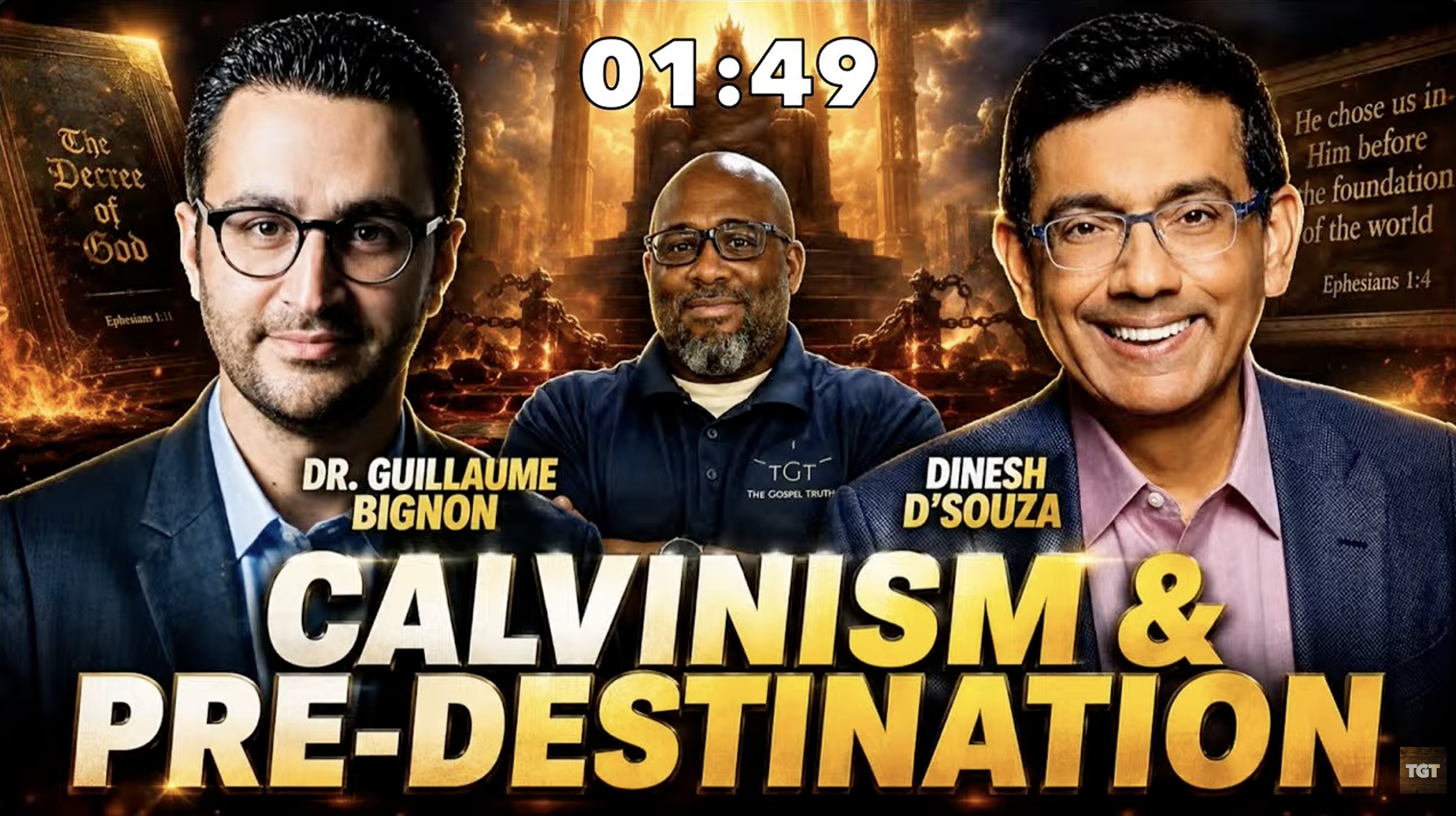
Debate analysis and rebuttal
The Gospel Truth, streamed 10 September 2026. Moderator: Marlon Wilson.
1. Summary verdict
Bignon won the debate as conducted and lost the argument as it should have been conducted. He controlled the framing (determinism v. indeterminism, compatibilism v. incompatibilism), extracted two damaging concessions, and never had a single text exegeted against him. D’Souza’s opening—an inventory of what the Calvinist God must have decreed—was rhetorically the strongest passage of the night, but he then fought on Bignon’s chosen ground (philosophy of moral responsibility) with borrowed tools, conceded the key philosophical premise, and never opened Romans 9 past verse 23.
Bignon is also the more consistent Calvinist on offer, and that consistency is his liability. He affirmed without qualification that God causally produced Lindsay Clancy’s murderous brain state, that God “made us sinners”, and that God determined the Qur’an in the same mode as the Apocalypse. The Westminster Confession will not follow him there: it ordains “whatsoever comes to pass” while insisting God is not “the author of sin” (WCF 3.1) and that sinful actions proceed “only from the creature, and not from God” (WCF 5.4). Bignon has abandoned the confessional hedge in favour of philosophical cleanliness. That is honest. It also removes every escape route the tradition built for exactly these objections.
2. Bignon’s four arguments, and what was wrong with each
Argument 1 — God brings about events through free human acts, therefore God determines all events
The texts. Isaiah 45:7, Amos 3:6, Lamentations 3:37–38 for the general principle; Genesis 45:5–8 / 50:20, Isaiah 10:5–15, Acts 2:23 / 4:27–28, and the inspiration of Scripture for specific instances.
The general texts do not say what he needs. Bignon himself read Isaiah 45:7 as “I make well-being and I create calamity”—which is correct: šālôm is set against raʿ, welfare against disaster, and the context is Cyrus, Babylon and the reordering of empires (45:1–13). He then quietly treated “calamity” as “moral evil”. Amos 3:6 asks whether disaster (rāʿāh) comes to a city unless the Lord has done it, in a chapter whose subject is covenant judgement on Israel (3:1–2). Lamentations 3:38 sits in the aftermath of Jerusalem’s destruction and is immediately glossed by 3:39: “Why should a living man complain about the punishment of his sins?” All three passages assert God’s authorship of judgement, which no one in the debate disputed. None asserts God’s authorship of the sins being judged. D’Souza saw this (“bad things are not the same as evil”) and was talked over.
The specific texts establish co-ordination, not determination. Genesis 50:20 is a two-intentions text: one event, two agents, opposing purposes—”you intended (ḥăšabtem) evil; God intended (ḥăšābāh) good.” The narrative of Genesis 37 attributes the brothers’ hatred to the brothers. If God determined their intention, then God intended them to intend evil, and Joseph’s contrast collapses into “God meant evil for good”. Isaiah 10 is worse for Bignon: Assyria is God’s rod (10:5), “but he does not so intend” (10:7), and God then punishes Assyria precisely for the arrogance of its own intention (10:12–15). The passage distinguishes God’s purpose from the instrument’s purpose and holds the instrument liable for the latter. Acts 2:23 and 4:28 predestine (proorizō) the death of Christ—an event within the class of redemptive-historical necessities. D’Souza correctly objected that the inference from this class to every act is a leap; he did not name the fallacy. It is a hasty generalisation of the unrepresentative-sample kind (Copi’s “converse accident”): “God determines some free acts” does not yield “God determines all free acts”, and every one of Bignon’s specimens is drawn from a marked category—the line of promise, covenant judgement, the cross, canonical revelation—precisely the cases where Scripture flags God’s extraordinary action. Bignon will reply that his inference is abductive (“best explains”), not inductive; the answer is explanatory competition: a rival model on which God appoints outcomes and uses agents whose intentions remain their own explains the same texts without the costs incurred at James 1:13 and Romans 3:8.
Inspiration proves the opposite. The Bible presents inspiration as an extraordinary act (2 Pet 1:21, “carried along by the Holy Spirit”). If that mode of divine action were God’s ordinary relation to every human will, the category would be empty. Bignon then affirmed that God produced the Marquis de Sade’s writings and Muhammad’s Qur’an by the same determination. He has not explained inspiration; he has dissolved it.
What should have been said. Every text Bignon cited shows God using human agents whose intentions the text treats as their own. That is the biblical pattern of sovereignty: rule over agents, not authorship of their willing. Bignon’s binary—determinist or indeterminist—is a philosophical partition imposed on data that presents kingship and responsibility side by side without a causal bridge. The bridge is Reformed, not biblical.
The history confirms it. Bignon’s demand for “a model”—open theism, simple foreknowledge, Molinism—assumes that anyone who reads Isaiah 45 and Amos 3 without determinism owes an account of how God secures outcomes. The pre-Augustinian church read those texts for four centuries without feeling the need, and at least one writer rejected the inference explicitly: “It is not the part of good and solid faith to refer all things to the will of God… else every sin will be excused” (Tertullian, De exhortatione castitatis 2). Wilson’s chronological reading of Augustine finds the bound will and unconditional individual predestination in no Christian writer before 412, and in Augustine himself only after decades of arguing the opposite against the Manichaeans. The “model” Bignon wants is the one Augustine imported.
Argument 2 — Calvinism best explains election, predestination and effectual calling
This argument was announced and never made. Bignon listed Ephesians 1, Romans 8, Romans 9 and Acts 13 and exegeted none of them. In the Q&A he read Romans 8:29–30 and asserted that “justified” and “glorified” are soteriological—true, and irrelevant to the question asked, which was where anyone is predestined to believe. Faith is not a link in the chain. The stated destination is “to be conformed to the image of his Son” (8:29); the stated purpose in Ephesians 1:4–5 is “that we should be holy and blameless” and “adoption… to the praise of his glory”. In both texts the purpose constructions attach God’s choosing to the shape of the life of those already “in him”, not to who comes to be in him. Predestination in Paul describes what God has committed himself to do for believers, not the mechanism by which unbelievers become believers.
D’Souza’s foreknowledge point was right as far as it went but stopped short. The stronger reply is not “God foresaw who would believe” but “the object of election is never a person’s eternal life as such”. Ask of every occurrence chosen for what? and the answer is a role, a task, a conformity, a service—never a decree of who will believe.
Acts 13:48 (hosoi ēsan tetagmenoi eis zōēn aiōnion) is the one text in his list with genuine force for the Calvinist, and the one that most needs handling on its own terms, because here the goal of the ordering is eternal life itself. Five observations.
The verb is not election vocabulary. Luke does not write eklegomai or proorizō; he writes tassō, “arrange, set in order, assign a place”, eight times in the NT. BDAG classifies 13:48 not under “order, determine, appoint” but under the sense of being placed in a class—glossed, roughly, “belong to, be classed among those possessing” (p. 991; verify the wording). That is the standard lexicon declining the decree reading on its own terms.
The reflexive sense is attested in Paul. 1 Cor 16:15, eis diakonian tois hagiois etaxan heautous, “they set themselves to the service of the saints”, is tassō + eis + goal used of self-disposition—the same syntactic shape as 13:48. The older Arminian rendering “disposed” (Whitby; Clarke) is therefore not a special plea; the sense is live in the apostolic idiom.
The immediate contrast carries an explicit reflexive. Two verses earlier Luke has the synagogue audience “thrust it aside” and “judge yourselves (heautous) unworthy of eternal life” (13:46). Same object, antithetical stance: those who set themselves against life, and those ordered toward it. The Reformed reading takes the asymmetry as self-exclusion versus divine inclusion; but the asymmetry Luke actually draws is between rejecting and gladly receiving the same word (13:46 apōtheisthe; 13:48 akouonta echairon), and the reflexive in v. 46 makes a reflexive or stative counterpart in v. 48 the natural reading.
Agent and time are unexpressed. When Luke wants divine appointment he says so: hōrismenos hypo tou theou (10:42), ho kyrios diēnoixen (16:14), prosetithei ho kyrios (2:47); Paul adds hypo theou to this very verb in Rom 13:1. The concession to make is Acts 22:10, tetaktai soi poiēsai, a divine passive of tassō with no agent named—so silence is consistent with a non-divine or self-referential ordering, not proof of it. And nothing in the verse says pro katabolēs kosmou; the perfect describes a state obtaining when they heard, produced at some unstated prior point.
Luke’s pattern supplies the prior point. Those who come to the Son in Acts are repeatedly those already answering the Father’s revelation: the God-fearers of 13:43 (though 13:44 widens the audience beyond them), Cornelius (10:2, 35), Lydia (16:14). This is the Johannine parallel—”everyone who has heard and learned from the Father comes to me” (John 6:45)—and it fits Luke’s apologetic purpose, which is to show Gentile inclusion as fulfilment of a work under way, not as a roll read before creation.
The argument should not rest on the middle voice. Most commentators (Barrett, Bruce, Fitzmyer, Keener, ad loc.) take tetagmenoi as passive, and it holds on the passive: the sentence is Luke’s narrative summary of who believed, with agent, time and ground all left open. Bignon needs all three; the text supplies none. It is a different kind of sentence from Eph 1:4–5 or Rom 8:29, where the purpose of God’s choosing is stated—and there the purpose is holiness, adoption and conformity to Christ, not who comes to believe.
Argument 3 — Moral responsibility does not require the ability to do otherwise
This was Bignon’s real case, and D’Souza lost it by conceding it: “You are philosophically right.”
The impeccability counterexample refutes a thesis nobody needed. Since Frankfurt’s 1969 paper, most incompatibilists have not grounded responsibility in leeway (alternate possibilities) but in source: an agent is responsible for an act when the agent is its ultimate origin and it is not determined by factors outside the agent (Kane 1996; Pereboom 2001, 2014). God’s inability to sin is the paradigm of sourcehood: his character is his own, uncaused by anything external. He is therefore no counterexample to source incompatibilism; he is its clearest instance. Bignon’s argument only touches leeway incompatibilism, and then—”from which it immediately follows that Calvinism and compatibilism are true”—commits a further error. Refuting one argument for incompatibilism does not establish compatibilism. Compatibilism is the positive thesis that determination by external factors is compatible with responsibility, and the strongest arguments against it are manipulation arguments (Pereboom’s four-case, Mele’s zygote), which do not depend on alternate possibilities at all. Theological determinism is not merely vulnerable to the manipulation argument; it is the manipulation case—an intelligent agent designing another agent’s psychology to guarantee a specific act. Bignon knows this literature (his book engages Pereboom directly) and presented the inference as if it were immediate. It is not.
The Pelagianism-or-universalism dilemma equivocates on “cannot”. Bignon: no one can live a sinless life; everyone is blameworthy for failing to; therefore ought does not imply can. The equivocation is between act-level and aggregate inability. A fair coin cannot land heads a million times running; each toss can land heads. A fallen human cannot complete a sinless life; each sin was avoidable at the point of commission—which is exactly what 1 Cor 10:13 asserts (“God… will not let you be tempted beyond your ability, but with the temptation will also provide the way of escape”). Blame attaches per act. “Failing to live a sinless life” is not an additional charge beyond the sum of one’s sins; it is a description of the sum. So: no Pelagianism (no one claims anyone will in fact live sinlessly, or that sinlessness saves), no universalism (each sin is blameworthy because each was avoidable). D’Souza’s retreat—”ought generally implies can”—handed Bignon the universal he needed. The right move was to deny the aggregate premise, not soften the principle.
The soteriological point Bignon never had to face. Condemnation in John turns on unbelief (3:18, 36; 16:9), and the gospel is commanded to all on the assumption that all can respond (Acts 17:30; Rom 10:8–13, “the word is near you”). If regeneration must precede faith, Bignon’s system does locate the decisive “cannot” at exactly the point where Scripture locates the “ought”. That is the real ought implies can problem, and it is his, not the non-Calvinist’s. Faith is the one thing everyone is told they can do; it is not a work, it is reception (Rom 4:5; John 1:12).
Argument 4 — Paul anticipates D’Souza’s objections in Romans 9, therefore Paul held Bignon’s view
This is an abductive argument (“my view best explains why these objections arise”), and it fails because the objections do not discriminate between the views.
Both readings predict the objection. Romans 9:14 and 9:19 arise from God’s purposeful use of Jacob over Esau and of Pharaoh’s hardening. On a vocational reading—God selects one line for the promise and raises up Pharaoh “that I might show my power in you, and that my name might be proclaimed in all the earth” (9:17, quoting Exod 9:16)—the objector still says “that’s arbitrary; how can Pharaoh be blamed?” The objection tracks God’s choosing for a purpose, not God’s determining every will. Bignon’s inference “you sound like Paul’s objector, therefore Paul held my view” requires that only his view generates the objection. It does not.
The potter is Jeremiah’s potter. Romans 9:20–21 draws on Jeremiah 18:1–11 (with Isa 29:16; 45:9), and Jeremiah’s potter is the most explicitly conditional image in the prophets: “If that nation… turns from its evil, I will relent… if it does evil in my sight… I will relent of the good” (Jer 18:7–10). Paul’s readers who knew the source would not hear an unconditional decree; they would hear a God who reshapes vessels in response to their turning.
“Endured with much patience” (9:22) is incoherent under determinism. Patience (makrothymia) presupposes waiting for a response that is genuinely open (Rom 2:4; 2 Pet 3:9). A potter does not exercise patience toward clay whose every movement he is producing.
Bignon stopped at 9:23. Paul’s own explanation of Israel’s failure follows immediately: they “did not pursue it by faith” (9:32), “did not submit to God’s righteousness” (10:3), were “a disobedient and contrary people” (10:21), were “broken off because of their unbelief” (11:20), and can be grafted in again “if they do not continue in unbelief” (11:23). The ground of the hardening is unbelief; the remedy is faith; the door is open. Romans 9–11 is a theodicy of Israel’s history answering “has God’s word failed?” (9:6), not a treatise on the eternal destiny of individuals. The vocational reading is not an evasion of Romans 9; it is what Romans 9–11 says when read to the end.
Romans 3:5–8 is Paul’s own rejection of Bignon’s theodicy. Bignon’s blanket answer—God is “causally responsible” for every evil intention but not blameworthy because he has good purposes—is the argument Paul puts in his opponent’s mouth (“if our unrighteousness serves to show God’s righteousness… why not do evil that good may come?”) and dismisses: “their condemnation is just” (3:8). Paul will not allow a greater good to launder an evil act for humans. Bignon’s only escape is a moral exception for God—”special access”, “his prerogative”—which is precisely the question at issue, not an answer to it. D’Souza circled this (the hitman analogy, the “one less abortion” question) without landing it.
3. Bignon’s auxiliary moves
The bobsled. Offered to show that “permission” language is meaningful under determinism. It shows the reverse. The team places the sled on the incline; the slide is their causal product; “allowing” describes the mode of causation, not a morally distinct relation to the outcome. Bignon conceded as much (“it’s determined just like the tsunami”). So his permission language does no moral work, and every place the tradition says “permits”, he must read “produces”.
The parity argument on evil. Bignon: the non-Calvinist also needs a greater good for the tsunami and for permitted moral evil, so we are in the same position. The asymmetry is doing versus allowing, which is basic moral ontology, not special pleading. Skeptical theism defends God’s permitting evils he does not cause. Bignon’s God does not permit the murderer’s intention; he designs and produces it. D’Souza’s “one less abortion” question exposed the further cost: a God who permits agents has a structural reason for not intervening case by case (the good of agency itself); a God who is already producing every brain state has no such reason, and so every individual evil is individually elected. Bignon’s answer—”obviously I don’t have the answer”—was the honest one, and the damaging one.
Romans 5:19. Asked who put the evil in David, Bignon cited “by one man’s disobedience the many were made sinners” and answered: God. The text does not say so. The agent named is ho heis anthrōpos; the passive katestathēsan is Paul’s way of setting Adam’s act against Christ’s act. Reading God as the suppressed agent of the passive is not exegesis but importation, and it commits Bignon to what WCF 5.4 denies.
“Free will is the control condition for moral responsibility.” A fair neutral definition. But Bignon then used the shared word to claim D’Souza’s constant appeal to biblical choice “doesn’t move the needle”. It does move it: the biblical presentation of choice as test (Gen 22; Deut 30:19; Job) is unintelligible if the outcome is authored by the tester. D’Souza’s Abraham and Job examples were good and went unanswered.
4. Where D’Souza went wrong
- Conceded the philosophical premise. “You are philosophically right” on impeccability surrendered the debate’s centre. The leeway/source distinction is thirty years old and would have neutralised the argument in a sentence.
- Softened ought implies can instead of attacking the aggregate premise. “Generally implies can” is a universal he did not need to lose.
- Never opened a text. No Isaiah 10:7, no Jeremiah 18, no Romans 3:8, no Romans 9:30–11:23, no 1 Corinthians 10:13. The entire biblical case was left to Bignon, who made it unopposed.
- Fought on “sovereignty” without defining it. “Delegated” and “limited” sovereignty accepted Bignon’s definition—exhaustive predetermination—and then apologised for reducing it. Sovereignty in Scripture is ultimate authority, not sole agency: God declares his purposes and brings them to pass (Isa 46:10–11), overrules human schemes (Ps 33:10–11; Prov 19:21), and turns the brothers’ evil to good without authoring it (Gen 50:20). A God who knows everything and can do anything is certain of the outcome without scripting the inputs; that is a stronger conception than the Reformed one, whose God can only be sure by fixing every variable. Stated that way, Bignon’s demand for “a model” (open theism, simple foreknowledge, Molinism) is exposed as his own definition of sovereignty smuggled in as a methodological requirement.
- Ran a rhetorical case where an exegetical one was needed. The hitman, the Jekyll-and-Hyde God, the 80/20 split are effective with an audience and useless against a philosopher who simply denies the transfer of blame. What Bignon could not deny is Paul’s own text.
What he got right: the opening inventory forced Bignon to own the full determinist position on record; the foreknowledge point on Romans 8:29 was correct in substance; the Abraham/Job “test” argument and the “one less abortion” question were the two moments Bignon had no answer for.
5. The line that wins
Bignon’s case rests on one inference repeated four times: from God’s purposeful direction of specific agents and events to God’s determination of every act and will. Break the inference and every argument falls with it. The way to break it is not philosophical but textual—showing, passage by passage, that the object of God’s choosing, sending, hardening and appointing is always a purpose (a line, a role, a judgement, a proclamation, a conformity) and never an individual’s eternal destiny as such. Bignon named Ephesians 1, Romans 8, Romans 9 and Acts 13 and did not read one of them. Had they been read, he would have been standing with Paul’s objector, not with Paul.
Sources
- Bignon, G. Excusing Sinners and Blaming God: A Calvinist Assessment of Determinism, Moral Responsibility, and Divine Involvement in Evil. Pickwick, 2018.
- Frankfurt, H. “Alternate Possibilities and Moral Responsibility.” Journal of Philosophy 66 (1969): 829–39.
- Kane, R. The Significance of Free Will. OUP, 1996.
- Pereboom, D. Living Without Free Will. CUP, 2001; Free Will, Agency, and Meaning in Life. OUP, 2014.
- Mele, A. Free Will and Luck. OUP, 2006 (zygote argument).
- Westminster Confession of Faith 3.1; 5.4.
- Wesley, J. “Free Grace” (Bristol, 1739) — Sermon 110 in the Bicentennial edition, 128 in Jackson; the “worse than the devil” charge D’Souza attributed to him.
- BDAG, s.v. τάσσω (p. 991).
- Barrett, C. K. Acts (ICC), vol. 1, 1994; Bruce, F. F. Acts (NICNT), rev. ed. 1988; Fitzmyer, J. Acts (AB 31), 1998; Keener, C. Acts, vol. 2, 2013 — all ad loc. 13:48.
- Whitby, D. A Discourse Concerning I. The True Import of the Words Election and Reprobation … (London: Rivington, 1816), pp. 71–72; Clarke, A. The New Testament of Our Lord and Saviour Jesus Christ (Philadelphia: Thomas, Cowperthwait, 1844), on Acts 13:48 — for the rendering “disposed”.
- Martin, R. P. “The Result of Paul’s Preaching in Antioch: ‘As many as were ordained to eternal life believed’ (Acts 13:48).” Reformed Baptist Theological Review 2/2 (2005): 27–35 — the Reformed case for the decree reading.
- Wilkin, R. N. “The Doctrine of Divine Election Reconsidered: Election to Service.” Journal of the Grace Evangelical Society (2012): 3–22.
- Meisinger, G. E. “The Issue of One’s Ability to Believe: Total Depravity/Inability.” Chafer Theological Seminary Journal 11/1 (2005): 66–96; Nichols, T. R. “A Free Grace Critique of Irresistible Grace.” CTSJ 11/2 (2005): 52–63.
- Tertullian, De exhortatione castitatis 2 (ANF/ANCL trans.).
- Wilson, K. M. Augustine’s Conversion from Traditional Free Choice to “Non-free Free Will”: A Comprehensive Methodology. STAC 111. Mohr Siebeck, 2018; lay edition The Foundation of Augustinian-Calvinism, 2019.
- Abasciano, B. Paul’s Use of the Old Testament in Romans 9 (3 vols.). T&T Clark, 2005–2022.
- Klein, W. The New Chosen People: A Corporate View of Election. Rev. ed., Wipf & Stock, 2015.
Scripture references from the debate transcript are as read by the participants (ESV wording); Hebrew and Greek as per BHS/WLC and SBLGNT.