
A Calvinist commenter recently put a challenge to anyone who thinks a person believes before God gives him new life. Read John 6:37-40, 44 and 65, he said, and tell us the sequence. Who draws whom, to whom, and for what? And what, or who, is missing?
Fair questions. Let’s answer them in order, reading the whole passage rather than the excerpt. Scripture is quoted from the HCSB.
The sequence John gives
The commenter’s list stops at verse 44 and jumps to 65. The verse in between is the one that settles the matter:
It is written in the Prophets: And they will all be taught by God. Everyone who has listened to and learned from the Father comes to Me. (6:45)
Jesus has just said that no one can come to him unless the Father draws him (v. 44). Verse 45 is his own explanation of what that drawing is. He quotes Isaiah 54:13 and describes it as teaching. The human response to that teaching is listening and learning. The result is coming.
So the sequence, in Jesus’s words, is: the Father teaches; the person listens and learns; the person comes to the Son.
Now, what is “coming”? Verse 35 puts the two clauses side by side: no one who comes will ever be hungry, and no one who believes will ever be thirsty. Coming to Jesus is believing in Jesus.
And what follows believing? Life.
For this is the will of My Father: that everyone who sees the Son and believes in Him may have eternal life. (6:40)
I assure you: Anyone who believes has eternal life. (6:47)
John repeats this order everywhere: 3:16, 5:24, 6:54, and in his statement of purpose for the whole book, “by believing you may have life in His name” (20:31). The Gospel’s sequence is taught, learned, believed, alive. The commenter’s sequence is alive, then believing. John never writes it.
Who draws whom
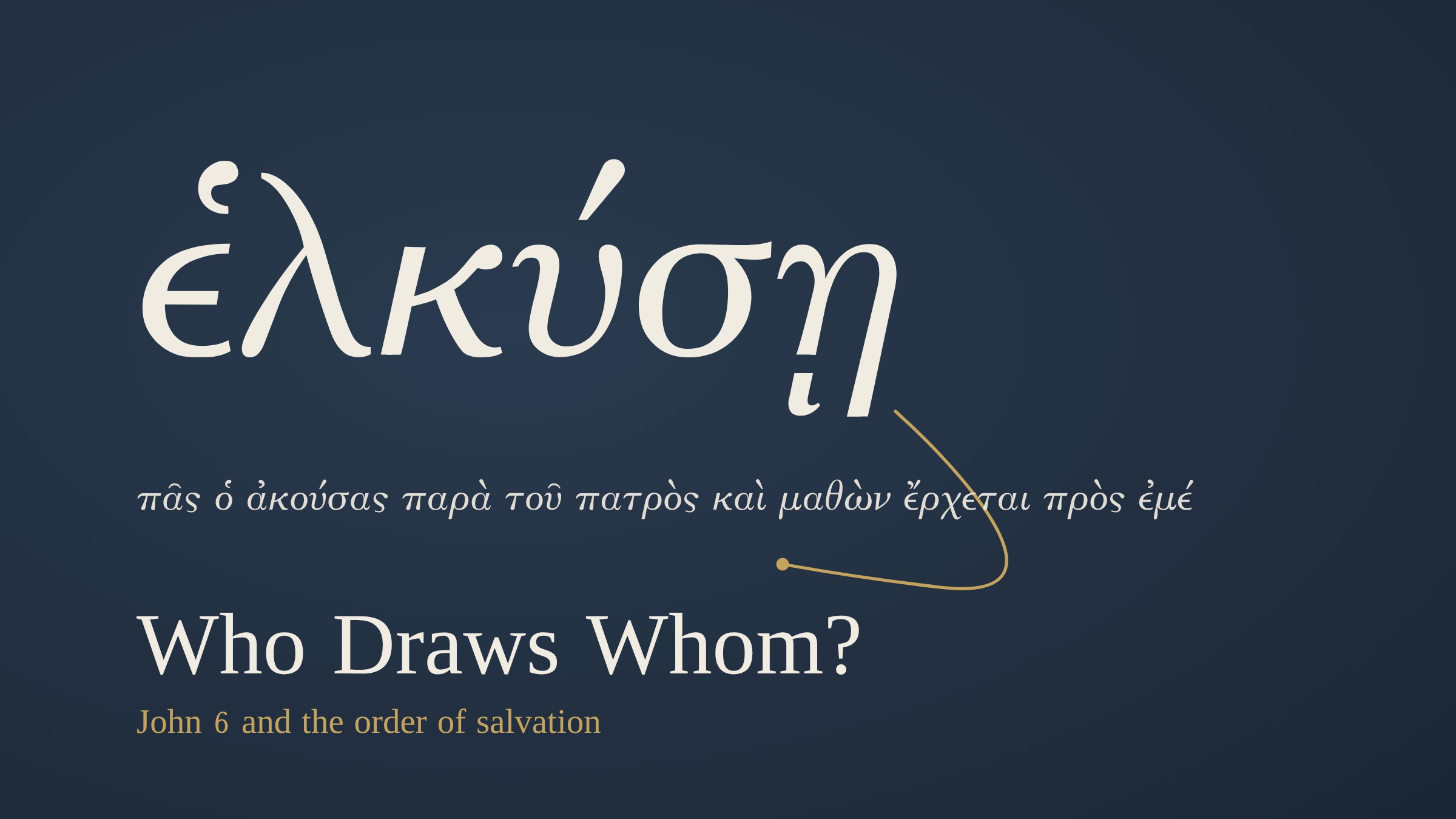
The Father draws people to the Son. Nobody disputes that. The dispute is over the verb. The Greek word (helkyō) is used elsewhere for dragging a net full of fish (John 21:6) or hauling men into court (Acts 16:19), so the argument runs that the Father’s drawing must be irresistible.
Three problems.
First, the same author uses the same verb a few chapters later: “if I am lifted up from the earth I will draw all people to Myself” (12:32). If drawing means irresistible dragging, then everyone is dragged to Christ, and everyone is saved. Nobody in this debate believes that. The usual escape, that “all” means “all kinds”, has to ignore what is going on in the chapter: Greeks arriving to seek Jesus (12:20) and the Pharisees complaining that the whole world has gone after him (12:19).
Second, when the Greek Old Testament uses this verb of God acting on people, it is the language of love, not force. “I have drawn you with compassion,” God says to Israel (Jeremiah 38:3 in the Septuagint, our 31:3). The Song of Songs uses it of a lover drawing the beloved (1:4). The standard Greek lexicon files John 6:44 and 12:32 together under drawing a person towards what is good for their inner life, in other words attraction, and lists the net-dragging passages separately.[^1]
Third, and this is the simplest point, a net has no will to resist. A person does. The verb tells you something is being pulled; it doesn’t tell you the thing pulled cannot refuse. Verse 45 tells you how the pulling works: by teaching.
Who is “given”
Verse 37 says everyone the Father gives to Jesus will come to him. The commenter reads “gives” as a decree of election from eternity. John gives it a more concrete meaning.
In his prayer, Jesus says of his disciples: “They were Yours, You gave them to Me, and they have kept Your word” (17:6). The ones given were already the Father’s. They belonged to God before they were handed to the Son.
That fits the setting of John 6 exactly. The crowd are Israelites arguing about Moses and the manna. One chapter earlier Jesus has told the same kind of audience where their unbelief comes from:
For if you believed Moses, you would believe Me, because he wrote about Me. (5:46)
And he has already diagnosed the problem as unwillingness: “you are not willing to come to Me so that you may have life” (5:40). Not unable. Unwilling.
The picture, then, is of a faithful remnant within Israel, people who had heard the Father through Moses, the prophets and John the Baptist, being handed over to the Son now that the Son has come. That is what “taught by God” in verse 45 means in its Isaiah context, and it is why Jesus can say later that those who are “from God” listen to his words while those who refused Abraham’s faith will not (8:39-47). The same logic governs “you don’t believe because you are not My sheep” (10:26): the sheep are those already listening to the Shepherd’s voice (10:27). Not one of these passages says the sheep were made sheep by a secret work before they believed.
What about verse 65, “no one can come to Me unless it is granted to him by the Father”? Read the verse before it. Jesus says some of them do not believe, and therefore reminds them of what he said. Not being given and not believing are the same group of people. The text doesn’t say one caused the other; verse 45 has already told us what the dividing line is.
What is missing
The commenter asked what was missing from the passage. The honest answer is: regeneration. Not the word, not the idea. Nowhere in John 6 does anyone receive life and then, as a result, believe.
The one place John does put birth and belief in explicit order, he puts them the other way round:
But to all who did receive Him, He gave them the right to be children of God, to those who believe in His name, who were born … of God. (1:12-13)
Receive, believe, given the right to become children, born. New birth is God’s work alone, which is the point of verse 13; but the condition John attaches to it is believing, which is the point of verse 12. This is not a quirk of John. Peter says we were born again “through the living and enduring word of God” (1 Peter 1:23); James says God gave us birth “by the message of truth” (James 1:18); Paul says the Ephesians were sealed with the Spirit after believing (Ephesians 1:13). David Allen’s survey of the texts concludes that the New Testament consistently places faith logically prior to regeneration.[^2]
Why does Satan bother?
One test of a doctrine is whether it makes the rest of Scripture strange. If unbelievers are incapable of faith until God regenerates them, and regeneration is irresistible, then the devil has nothing to do. The elect cannot be stopped and the rest cannot be started.
Yet Jesus says the devil snatches the word from hearers’ hearts “so that they may not believe and be saved” (Luke 8:12), and Paul says the god of this age blinds the minds of unbelievers so that they will not see the light of the gospel (2 Corinthians 4:4). Both writers assume that, left alone with the word, these people might well have believed. The devil’s activity only makes sense if faith was within reach.
Jesus assumes the same thing about ordinary people. When the crowd in John 6 asks what work God requires, he answers, “that you believe in the One He has sent” (6:29). He answers a question about what they can do by telling them to believe. Later he says, “If anyone wants to do His will, he will understand whether the teaching is from God” (7:17). Wanting comes first; recognition follows.
Who is missing
There is one act of choosing in John 6, and it is worth reading to the end of the chapter to find it:
Didn’t I choose you, the Twelve? Yet one of you is the Devil! (6:70)
The only election the chapter records is a choice of twelve men for an office, and it includes Judas. If John 6 teaches unconditional election to eternal life, someone has to explain why the one explicit election in the chapter is neither unconditional in its outcome nor about eternal life at all.
Back to the question
Who draws whom? The Father draws people to the Son, by teaching, and those who listen and learn come. Who is given? Those who were already the Father’s, handed to the Son. What is missing? Any statement that life precedes faith. Who is missing? Nobody, as it turns out. The sinner is right there in every verse, coming, believing, listening, learning, or refusing.
John’s order is the order of the whole New Testament: hear, believe, live. It is also, not incidentally, the order of the gospel invitation. You are not told to wait until you have been made alive. You are told to believe, and live.
[^1]: BDAG, A Greek-English Lexicon of the New Testament and Other Early Christian Literature, 3rd ed., s.v. ἑλκύω.
[^2]: David L. Allen, “Does Regeneration Precede Faith?”, Journal for Baptist Theology and Ministry 11, no. 2 (2014): 34-52.